DOM HENRY WANSBROUGH OSB1
The First Reading Isaiah 50:4-7: The four Songs of the Servant of the Lord occur in the second part of the Book of Isaiah, pronounced by the prophet in the last days of the Babylonian Exile, a time which was vital for the consolidation and re-formation of Israel. They seem to hang together and form a body somewhat, but not entirely, separate from the rest of the prophecy.
The third Song sings of the suffering accepted by the Servant for the Lord, humiliation, insult and spitting.
Who, then, is this Servant? In its primary meaning it has been understood as the prophet himself, reflecting on his own experiences as God’s messenger to Israel, though the difficulty here is that, as well as having a mission to Israel, he is identified as part of Israel. Is that identification in the second Song a later addition? The sufferings described in other Songs must be personal. Perhaps it is the prophet precisely as identified with Israel. Should a further extension of the meaning be understood as the long-term suffering of the People of God in witnessing to the values of Judaism? Certainly Christianity sees the prophecies to be fulfilled in the mission and sufferings of Jesus.
The Second Reading. Philippians 2:6-11: This hymn was probably not written by Paul himself, but taken up by him into the letter, a very early Christian hymn. It celebrates the triumph of Jesus through his selflessness. The assertions at the end are staggering. The hymn claims for Jesus the titles and the worship which are due only to God. What is more, this acknowledgement of Jesus does not detract from the glory of God, but is precisely ‘to the glory of God the Father’. This is perhaps the fullest statement in Paul of the divine glory of Jesus, and it is won by his humiliation in death.
The Passion according to Matthew 26:14-27:66: The accounts of the Passion given by the four evangelists are not identical. The basic outline of these dreadful events was clear enough. It is confirmed by the contemporary Jewish historian Josephus, who tells us that Jesus was crucified by Pontius Pilate at the instigation of the Jewish leaders. The task of the gospel-writers is not to relay to us the raw facts, but to help us understand their significance. Each stresses a particular aspect. For instance, John underlines that this was the triumph of Jesus: he shows his divinity already at the arrest-scene. He himself yielded up his Spirit only when he had completed his task. Matthew’s preoccupation with Judaism dictates that he show in detail how the events accord with God’s plan revealed in the scriptures. Almost every incident is told in such a way that hearers familiar with the scriptures would catch allusions to the biblical writings: nowhere is this more obvious than in the account of the death of Judas. Though Pilate the governor must bear the final responsibility, Matthew also stresses the pressure put on him by the crowd manipulated by the politically adept Jewish authorities, culminating in the horrific cry, ‘His blood be on us and on our children’ – an allusion to the sufferings undergone by the next generation during the siege of Jerusalem by the Romans. The significance of the events is further underlined by the apocalyptic earthquake at Jesus’ death, and by the immediate release of the blessed dead, who come at last into the Holy City.
***
Rev Dr FRANCIS J MOLONEY SDB2
Although Matthew is using a pattern to tell the story which he has taken from the Gospel of Mark, our Evangelist insinuates his own point of view. An example of this can be found in the way Matthew reports the last meal of Jesus with his disciples. Matthew intensifies the portrait of failing disciples. In the narrative before the meal (Mt 26:21-25) the Evangelist Matthew heightens the drama of Judas’ betrayal. Mark has a general indication that ‘one of you’ (Mk 14:18), ‘one of the twelve’ would betray him (14:20). This indication is followed by the lament over ‘that man by whom the Son of Man is betrayed’ (14:21). Judas is never named, nor does he enter the story actively. The reader knows who is in question.
Matthew deliberately refashions Mark’s version of the story and even the words of Jesus to stress Judas’ failure. Jesus first indicates generally ‘one of you is about to betray me’ (Mt 26:21). He then shifts away from Mark’s reference to one of the Twelve ‘who is dipping into the same dish with me’ (Mk 14:20) to state with specific reference to an action already completed before the eyes of all: ‘Someone has dipped his hand into the dish with me’ (Mt 26:23). After the lament over the betrayer, Matthew has Judas himself enter the story: ‘Judas, who was to betray him, asked in his turn, “Not I, Rabbi, surely?” “They are your own words” answered Jesus’ (26:25). In Matthew, little is left to the imagination. One of the Twelve, whose name was Judas, is the betrayer. Matthew sets the scene of a clearly defined and named disciple who has shared a sacred meal with Jesus. He can now tell the story of the supper itself.
Moloney, Francis J. This is the Gospel of the Lord Year A: Reflections on the Gospel Readings (Function). Kindle Edition.
***
RGG
The Donkey3
When fishes flew and forests walked
And figs grew upon thorn,
Some moment when the moon was blood
Then surely I was born.
With monstrous head and sickening cry
And ears like errant wings,
The devil’s walking parody
On all four-footed things.
The tattered outlaw of the earth,
Of ancient crooked will;
Starve, scourge, deride me: I am dumb,
I keep my secret still.
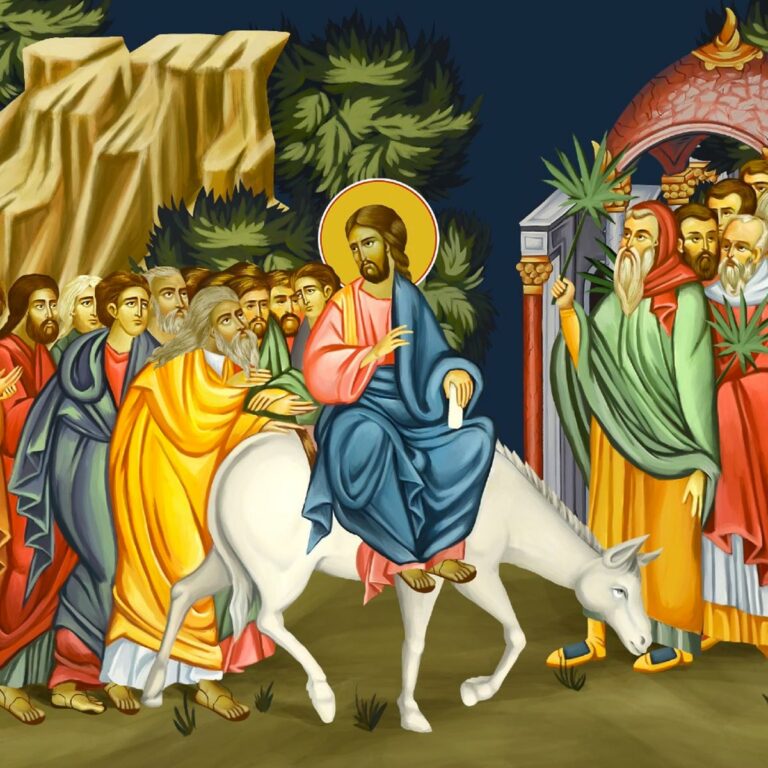
Fools! For I also had my hour;
One far fierce hour and sweet:
There was a shout about my ears,
And palms before my feet.
G.K. Chesterton
MEMO: OREMUS and QUOTIDIANO will be in Recess from Passion Sunday until Easter Monday. I will be travelling on these days with family.
☘️
- Commentary available on UNIVERSALIS ↩︎
- Moloney, Francis J. This is the Gospel of the Lord Year A: Reflections on the Gospel Readings (Function). Kindle Edition. ↩︎
- (taken from UNIVERSALIS “today” Pslm Sunday) ↩︎
Leave a Reply