TO ACCESS ARTICLE ONLINE CLICK ON IMAGE ABOVE
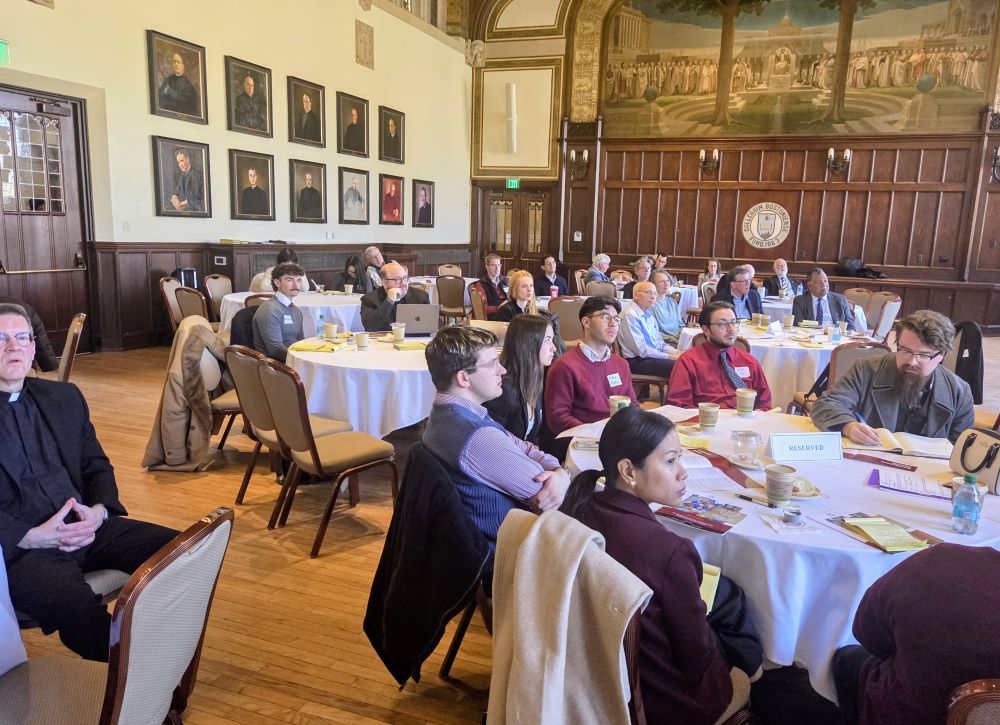
Last week, I attended a conference at Boston College that brought together legal scholars and theologians to discuss the “The Rule of Law and the Common Good: An Emerging Synergy between Legal Theory and Catholic Social Thought.” The words “natural law” were not in the conference’s title, but it was that aspect of Catholic social thought which dominated the conversation. At a time when the rule of law has been taking a beating, it turns out that our Catholic understanding of natural law might provide some help.
The natural law has occupied a distinctive, and somewhat regrettable, place in Anglosphere Catholic discourse in recent years. In the hands of writers like George Weigel and scholars like John Finnis and Robert George, an invocation of the natural law has been a conversation ender, not a conversation starter. Their deductive, somewhat Kantian understanding of natural law is something to which they expect adherence, not something to be discussed and developed. Consequently, natural law acts as a leveler and its usefulness in fleshing out the common good in a pluralist society is limited.
The conference at Boston College sought to reclaim natural law from the conservatives and introduce a more inductive approach to determining its content. One of the key points of focus was the inadequacy of the rule of law when conceived as merely a procedural norm, an exercise in due process. Jesuit Fr. Frank Brennan from Australia noted that Catholic social teaching requires a rules-based social order that protects human dignity. It is easy to see how the rule of law helps achieve this, protecting against arbitrary power and ensuring equality before the law. But, is more substantive content needed?
Brennan pointed to Pope Benedict XVI’s 2010 speech to the British parliament in Westminster Hall, specifically the pope’s insistence that “objective norms governing right action are accessible to reason, prescinding from the content of revelation,” that is, the natural law. Benedict continued:
According to this understanding, the role of religion in political debate is not so much to supply these norms, as if they could not be known by non-believers — still less to propose concrete political solutions, which would lie altogether outside the competence of religion — but rather to help purify and shed light upon the application of reason to the discovery of objective moral principles.
Brennan also cited Pope Francis’ 2014 address to the European parliament in Strasbourg for clues. Francis asked, “What dignity can there be without a clear juridical framework which limits the rule of force and enables the rule of law to prevail over the power of tyranny?”
University of Notre Dame’s Mary Ellen O’Connell noted that natural law has been supplanted in law schools with the “law and economy” approach that was developed at the University of Chicago in the 1950s. Her criticism tracked with that of Pepperdine University’s Jason Blakely in his book We Built Reality. The humanities have paid a steep price for abandoning their own methodology to adopt the drag of scientific precision. And, ironically, the University of Chicago is beginning to understand how corrupt the approach it created has become as seen in this recent panel it hosted with economist Sam Bowles. O’Connell called for a return to teaching the natural law theory of Hugo Grotius to law students.
The next morning, Durham University’s Anna Rowlands rescued the discussion from any facile, imprecise understanding of the changes in Catholic social teaching enacted in St. Pope John XXIII’s 1963 encyclical Pacem in Terris and, even more, in the decrees of the Second Vatican Council. Against the pedestrian reading of the council as embracing the norms of the Enlightenment, Rowlands argued:
… what shifts [in Pacem and at Vatican II] is not the Church towards the Enlightenment, but towards a Catholic modernism expressed as a morally ordered personalism. Personalism, born out of a resistance to individualism and totalitarian anthropologies, and with both Thomist and liberal paternity, facilitates the inversion of Pacem, which does not abandon natural law or the moral order but makes the person, in relation to other persons, its ontological, epistemic, and political-legal core.
This shift was not without its critics, and Rowlands cites philosopher Simone Weil’s concerns about personality anchoring a social order, of rights divorced from “an account of basic human needs” which are “both material and moral,” and of the necessity of highlighting human obligations “which bind us even when there’s no functioning state left to guarantee rights. Rights relate to collectivities necessary to make them real; obligations attach to persons and endure when collectivities fail.” Here is the finest, most humane criticism of the human rights tradition you are ever going to read.
Rowlands thinks natural law can help resolve these competing tensions, but only if it is freed from the Kantian approaches of the past and permitted to fashion a new “political anthropology.” She said, “In creating versions of natural law theory that better pay attention to the historically conditioned, evolved sociability of our nature, we will better attend to the task of law and challenge the permanent temptation to turn the rule of law back into the rule of men or individuals.” Here is the inductive natural law approach, capable of engaging with the pluralism of modern society, yet robust enough to resist tyranny.
Irish Jesuit Fr. Patrick Riordan looked at some of the neuralgic issues in any attempt to introduce substantive natural law content into the rule of law, for example, asking: “If it is thought desirable to include some substantive content among the largely procedural principles of the Rule of Law, would the right to private property be a candidate for inclusion?” It is a tricky question, not least because some thinkers are invested in a natural right theory of property and others in a natural law theory of property. Examining some magisterial tests, Riordan concluded that, among other things, adding substantial content to the rule of law is “fraught with danger.”
Holy Cross College President Vince Rougeau brought the theoretical conversation into the reality of the day.
“In this particular moment, I believe we are witnessing an extraordinary challenge to our nation’s longtime understanding of living under the rule of law, not only due to questionable — one might argue, lawless — actions by the executive and the executive branch, but also due to the failure of the legislative branch to engage responsibly in the discourse and activity necessary to frame and execute laws,” he said. “One consequence has been a surge in notable acts of aggression and dehumanization by the executive branch directed toward some of the weakest and most vulnerable members of our society.”
He also echoed Riordan’s point on the differences between a natural right and a natural law theory of property, between an individualistic and a more social understanding of property, and linked it to O’Connell’s critique of the law and economics school.
One feature of this conference that stood out was the profundity of Benedict’s speeches to various democratic assemblies, and how Francis built on that. History will be increasingly kind to Benedict and it is not difficult to imagine Leo XIV, like Francis, building on the German pope’s intellectual foundations.
The papers will be published and make a fine contribution to both the legal and the theological communities. These issues are vitally important and it seems like most Americans took the rule of law for granted. Didn’t we all watch the Watergate hearings? Or at least watch the movie “All the President’s Men”? The abstract issue of whether or not to introduce substantive content into the procedural conception of the rule of law is difficult but essential. The question of how we train future lawyers in our law schools, and how to reconcile a deductive and an inductive approach to fashioning our understanding of the natural law, are heady issues with real-world consequences.
For example, it is important for academics to grapple more thoroughly with why so many Americans do not care so much about the rule of law. Workers who lost their jobs after NAFTA and other trade agreements, and those who lost their homes during the 2008 housing bubble and economic meltdown are not wrong to ask where the rule of law was to protect them. The rule of law has not prevented a massive concentration of wealth nor has it inhibited the growth of an AI industry that is largely free from any form of regulation. So, those who care about building a healthier society need to think about both the need for rule of law in the making of a just and healthy society and how it is insufficient alone to fashion such a society. This conference got several vitally important conversations moving. I hope its published form ignites that discussion further.

BY MICHAEL SEAN WINTERS
Follow on Twitter at @michaelswinters

Leave a Reply