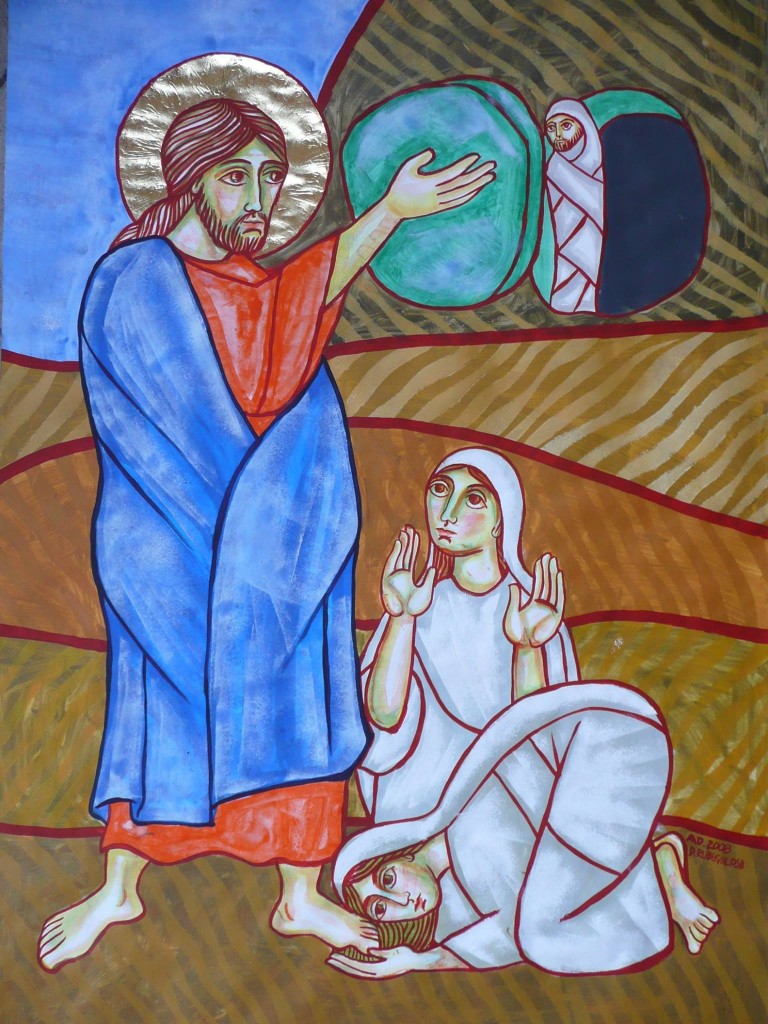
Untie Him and Let Him Go
Friends, all three readings give us vivid images of death, the grave, and rising from the dead. Each author begins with the conventional understanding of death and the grave as finality; however, they deliberately set God’s action against that assumption. In the First Reading, God’s action is wrapped in a promise: “I will open your graves and have you rise from them and bring you back to the land of Israel.” In the Second Reading, the focus shifts from physical death to existential and moral death—from the grave as earth to the grave as the body—and the author weaves into this condition God’s action of raising the one dead in sin to new life in Christ through the indwelling of the Spirit. The grave is no longer an end but a medium through which God works. Nowhere is this tension clearer than in the Gospel Reading, in the death of Lazarus and the exchange between Martha and Jesus. Martha is precise in her description of her brother’s condition—he has been in the tomb for four days. As she says, “Lord, by now there will be a stench.” Jesus does not dispute her assessment; He redirects it from despair to hope. He responds not by confirming what she believes is possible, but by inviting her into what He believes should be expected: “Did I not tell you that if you believe, you will see the glory of God?”
The glory of God in this instance is not an abstract phrase but a concrete action—God manifesting Himself within us. As seen in the Gospel reading about Lazarus, this glory unfolds through a deliberate, methodical act of God. He meets us where we are and in what we have become: dead men and women. Then He calls us out, by name, from our graves—whether a physical grave like Lazarus or the moral and existential graves described by Paul in the Second Reading. But the key point is this: He calls us out. He does not leave us there because the grave is not our destination. He is our end. We proceeded from Him, and we shall return to Him. Our sins and deviations are not what define us. He does not hold them against us; instead, He feels the pain and harm we have suffered along the way. And He comes to make all things right, including our death. No wonder Paul exclaims in 1 Corinthians 15:55, “Death, where is your victory? Death, where is your sting?” And in verse 57, he adds, “But thanks be to God, who gives us the victory through our Lord Jesus Christ.” That victory is new life—more precisely, restored life. For the life God gives, much like energy in the Law of Thermodynamics, is not destroyed but transformed.
However, the Gospel author adds an important nuance to God’s action. While it is God who restores life—who transforms it—it is the community that must participate in releasing that restored life from what binds it. This is akin to what Johann Baptist Metz calls dangerous memories: those lingering, painful, constricting remnants of the past that hold a person back from flourishing. Even after Lazarus is raised, he remains wrapped in the cloths of the grave. In a real sense, he is still bound—unable to walk, unable to live, still entangled in the signs of death. And so, Jesus turns to the community and commands, “Untie him and let him go.” The miracle of life restored is God’s work; the work of unbinding belongs to us. This command is not restricted to the community of Lazarus’s time. It is a command God gives today. We are to reenact and participate in untying those whom God has already raised from their deaths and graves. And here the Gospel writer offers a profound twist: the community itself experiences restored life precisely in the act of unbinding Lazarus. This is the Christian drama. We become more fully ourselves, we flourish, and we live the resurrected life not in isolation, but by participating in the life and liberation of the other. Therefore, as we approach Easter, let us heed the command, “Untie him and let him go.”
Leave a Reply