The Origins of a Theological Legend
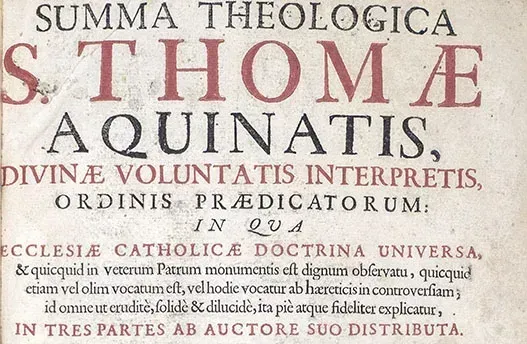
Have you ever believed something because you wanted it to be true, even if you really didn’t have the evidence to support it? Something too good not to be true?
In his 1879 encyclical Aeterni Patris proclaiming the special place of St. Thomas Aquinas in the study of philosophy and theology among Catholics, Pope Leo XIII wrote:
[T]he chief and special glory of Thomas, one which he has shared with none of the Catholic Doctors, is that the Fathers of Trent made it part of the order of conclave to lay upon the altar, together with sacred Scripture and the decrees of the supreme Pontiffs, the Summa of Thomas Aquinas, whence to seek counsel, reason, and inspiration.
Almost exactly three years ago, I expressed my doubts about this historical anecdote. After all, at the Council of Trent the Franciscan theologians who followed either St. Bonaventure or Bl. John Duns Scotus outnumbered the Dominican disciples of Aquinas, and the bishops deliberately avoided attempting to settle the matters of dispute between the different schools of Catholic theology, instead focusing on defining Catholic doctrine on the key questions raised by the Protestant Reformation. Even more, the bishops also agreed to avoid scholastic language as much as possible in their dogmatic decrees, instead adopting a more scriptural approach. It would be odd, then, to have given such a prominent place—alongside the Bible itself!—to the work of a single scholastic theologian, even if an extremely eminent one.
Just by happenstance, I discovered the truth of the matter concerning Aquinas’s Summa at the Council of Trent. It turns out that I was right to be skeptical. The truth, however, is more humorous than I expected, but it also offers an important lesson. Back in 1918, a Capuchin scholar named only Fr. Michel-Ange uncovered the historical origins of this tale and its transmission over the centuries. Michel-Ange’s findings were then summarized by the Dominican historian Fr. Angelo Maria Walz in his history of the Dominicans’ involvement at the Council of Trent, first published as a series of articles in the 1940s as part of the celebration of the 500th anniversary of the opening of the council, and then republished and updated as a book in 1961.
The first known account of Aquinas’s Summa being place on the altar at Trent comes in 1647, more than eighty years after the closing of the council, in a book titled Politica Cristiana by an author named—if you can believe it—Tommaso d’Aquino. This Tommaso d’Aquino, however, was not a Dominican, but rather a canon regular, a type of priest who lives in community according to a religious rule (typically the Rule of St. Augustine). Here is how he puts it (translated from the Latin):
To report [the matter] with most worthy faith, in the great aula where the most devout prelates and most learned Fathers of the Holy Synod of Trent were gathered, there stood a table heavy with the weight of sacred books, on which were seen these sacred codices: the Holy Scriptures, the sanctions and decrees of the Pontiffs, and the Summa of St. Thomas.
This version of events was passed on by several theologians over the next two centuries until it appeared, in almost identical form, in Pope Leo XIII’s encyclical. The story was later repeated by Pope Pius XI in his 1923 encyclical Studiorum Ducem, which reinforced the central place of Aquinas’s theology in seminary education.
Walz points out, however, that not only is there no earlier source from closer to the time of the council that mentions this episode, but also that it also cannot be found in more erudite, historical sources where one would expect to find it, such as Cardinal Francesco Sforza Pallavicino’s history of the Council of Trent (1656-57) and Jacques Échard’s lengthy history of the Dominican Order (1721).
Perhaps cognizant of the scanty historical record, the seventeenth-century theologian Barthélemy Camblat, a member of the religious order known as the Congregation of Christian Doctrine, embellished Tommaso Aquino’s original story by attempting to link it to a more concrete episode from the council. Camblat’s version of events appears in his 1663-64 book tellingly titled Opusculum de perpetua doctrinæ S. Thomæ Aquinatis in scholis et in Ecclesia authoritate (“A little work on the perpetual authority of the teaching of St. Thomas Aquinas in the schools and in the Church”). According to Camblay, the Archbishop of Granada, Spain, Cardinal Pedro Guerrero, appealed to the III Pars of Thomas’s Summa in one of the conciliar debates over the Mass. He writes (translating from Latin):
The Archbishop of Granada immediately had at his disposal the III Pars of the Summa of St. Thomas, which he would not have been allowed to have so close to him, unless, as was said, the Summa of the Angelic Teacher had been placed in that same holy place, so that whoever was absent in person would be present in writing, according to the words of the Orator of Trent.
In other words, the archbishop could not have had such ready access to such a specific text from the Summa unless the book was already present there in the council aula. Camblay’s embellished narrative was likewise passed on into the nineteenth century.
Walz deduces that Camblay must be describing the discussion of the Decree on Communion Under Both Species from the council’s twenty-first session in 1562. If that’s the case, however, then the eyewitness account of Cardinal Gabriele Paleotti, the Archbishop of Bologna, recorded in his diary from the council, differs from Camblay’s in an important respect (again translating from Latin):
[The Archbishop of] Granada directs his servant to bring the book of St. Thomas from his residence and points the legates [i.e., the representatives of Pope Pius IV at the council] and the others to the III Pars of the Summa, q. 80, a. 11. [emphasis added]
The copy of the Summa in question, then, was not on the altar alongside the Scriptures and decrees of the popes but rather belonged to the personal library of Cardinal Guerrero.
Walz concludes his treatment of this episode by stating that Thomas Aquinas’s reputation as a theological authority does not depend on legends but rather speaks for itself. That’s certainly true, but Pope Leo XIII’s purpose in Aeterni Patris was to propose Thomism as a unifying intellectual framework for Catholics in the modern world. It was tempting, then, to give undue credence to a historical anecdote that seemed to project the authoritativeness of Aquinas’s theology back into the past while minimizing the theological diversity of the Tradition. Trying to make sense of the Church’s Tradition certainly involves trying to find coherence in the facts of the past, but it also has to include due regard for the diverse, divergent, and unexpected trajectories we find in the Church’s history and resisting too tidy narratives.

Leave a Reply