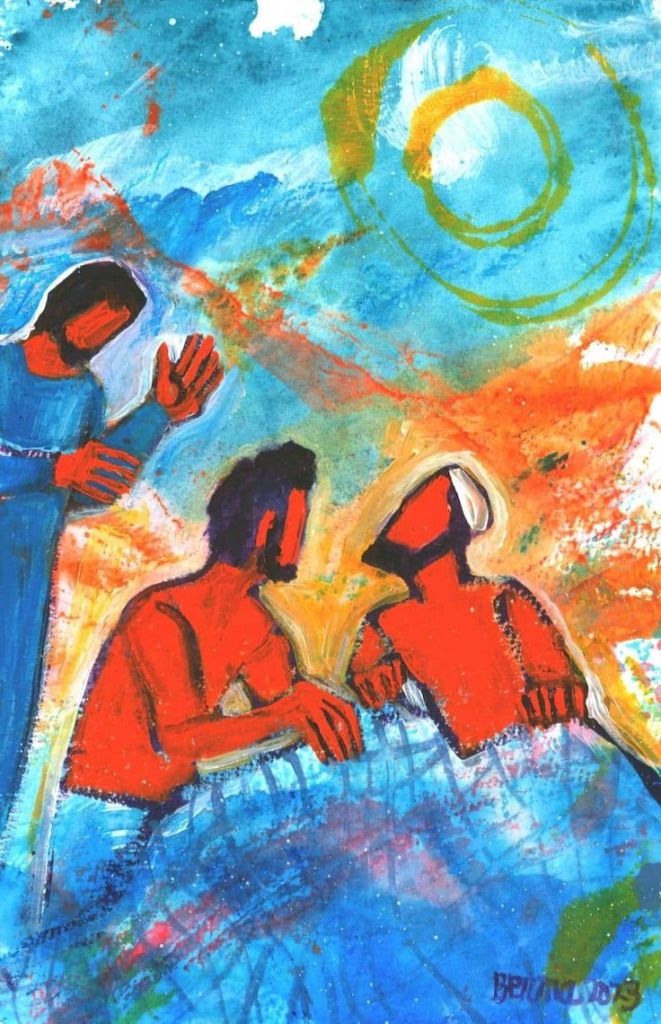
Matthew 4:18-20
DOM HENRY WANSBRROUGH OSB
This is the beginning of Jesus’ ministry. Matthew first introduces us to Galilee, characteristically quoting the scriptures to show that they are being fulfilled, and in what way. Galilee is called ‘Galilee of the gentiles’ only in this passage, and it was not a particularly notable feature of Galilee. Archaeology shows that Jewish observance was strong in the region. Contemporary literature shows that there was a lively tradition of prayerful charismatic rabbis with a warm devotion to the Lord. Jesus begins his ministry by proclaiming the imminence of the Kingdom of God, which will be the subject of all his activity. Then he begins to form the new Israel by calling his team together. The Christian imagination tends to combine this scene with the scene with the Baptist in the Jordan Valley in the gospel of John, which gives at least Peter and Andrew some knowledge of Jesus. But today’s narrative must be heard on its own, and the staggering factor is that this is the first time at any rate the sons of Zebedee have set eyes on Jesus. As he passes by he calls them, and such is the electrifying power of his charismatic personality that they simply drop everything and follow this total stranger – immediately, as the evangelist stresses each time.1
Dr FRANCIS J MOLONEY SDB
The Evangelist Matthew has drawn a portrait of the way the Lord breaks into the life of his disciple. But as our own experience of discipleship teaches us, our response does not always match the ideals portrayed here. The Evangelist deliberately idealises the vocation of the first disciples to show that Jesus’ presence has already set into motion God’s reigning presence among us. God’s kingdom is present when disciples respond unquestioningly to the mystery of God’s ways.
It is not only in the story of human beings that God exercises his kingship. The powers of sickness and evil can never be victorious against it. Indeed, wherever Jesus went proclaiming the Kingdom, its presence was immediately obvious (v. 23). All kinds of disease and sickness simply cease before the power of God’s goodness. Perhaps the absence of God’s presence as King among us and the presence of so much sickness and evil is in some way linked with the ambiguity of our response to his summons to follow Jesus2.
***
RGG
You have already encountered what I have to offer on this Sunday’s Gospel incident in previous Reflection postings. And they were pretty good in my opinion(!). So what is to follow, I guess, might be lean pickings on past prayerful lectio. Anyhow, what do we have from our “lectio” this week?
Well the scene at the Sea of Galilee is a long long way from the religionist tableau of cultic obsession. None of the dramatis personnae are wearing lace.3
Notice Christ is walking. Pope Francis the Great said, unless the Church is on the move, it is dead.4 Notice Jesus “sees” men who are 1 brothers; 2 working; 3 not bowing and scraping in the temple; 4 at their Father’s business, powerfully symbolic; and seemingly ‘real’ men, married, not gender strugglers and the sexually confused, no time for contemporary narcissism here. No personal dogs around in this scene. It is a wonderful scene. Jesus seems to call real blokes, who can work, be brothers, and are happy in their Father’s business. Goodness, I find this powerful …..this is the proto-vocation theology.
Jesus calls them to follow Him, and as we know from elsewhere, He will form them into fishers of persons… i.e., Formation as Missionary Disciples as we would understand it today. Jesus never gave them a biretta, and told them to forget psycho-social health and maturation… and that by not becoming a real human being, one was not ready for the CALL to follow. There is nothing in the call at Galilee that involves dressing up in ridiculous religionist splendour, albeit of a bygone age, aping the 19th century as though that is Catholic perfection. All this is so so ridiculous. He called real blokes, mostly married probably, who would not fluff around the Church, and who could be brothers, and could work in the “Father’s Business”. Goodness, I find this immensely powerful as teaching this Sunday. And so very Catholic.
Trads with their recto tono5 ... their ritualism, their religionism, their ideological attitude; their certainty which defies faith in the contest of doubt, their pedestal priesthood, their disregard of ordinary faithful and their dissent from 19th century ecclesiastical regimentation. And the women? Ah, well, that is blazingly obvious!
The Trads have seemingly opted for Religionism rather than the Faith of the Gospels and faithful Catholicity. … and so they have become a cult, a self-styled religion. But they have no seeming communion with Jesus Christ, Our Living Lord, who is always with us in His Church6. For Pope Francis, it runs dangerously into a new gnosticism; a neo-pelagianism7; and of course is riddled with indietrismo8.
Deacon Douglas McManaman writes in his homily for the 2nd Sunday A (last week).
It is rather easy to live a kind of religious life that amounts to a continuous evasion of the cross. We see this, for example, in those who, while they love liturgy, vestments, incense and candles, processions and liturgical drama, will demean others, look down upon them, make their authority felt, and use religion to oppress others, especially women.
The Church is a strange mixture of the divine and the human, holiness and sin, a mystery that can only really be understood from the inside. We see the results of this tragic mixture all throughout the history of the Church alongside those who are genuinely saintly, like Don Bosco (who devoted his life to poor youth on the streets during the time of the Industrial Revolution), Vincent de Paul, Mother Teresa of Calcutta, Benedict Joseph Labre, Padre Pio, and John Neumann (who dedicated his life to the immigrants of Philadelphia, learning 8 languages in order to hear their confessions and who died on the street at 48 years of age while running some errands). And when I look back at my own life, I have encountered those who have been a negative influence, who have done harm and have driven people away from the Church by their misogyny, legalism, and abuse of authority and who made their priesthood principally about them. But, I have also encountered great men and women who had a tremendous influence on me, such as a very humble Salesian priest, an unpretentious and joyful diocesan priest from Washington D.C., who was violently murdered during a robbery, and countless women who were hidden vessels of divine patience, carriers of the divine light and love.9
Jesus sees them at work in their Father’s business; they are brothers, not hanging round the Temple all day simulating clerics and all dressed up in fashions ages past; He sees the ones who are about lives and livelihoods. He sees them there, He calls, they hear and follow Him, and they don’t ask for the rule book first. No cult, no religionism here. Only encounter with the Christ – the WORD. And so the Church is underway in formation as Christocentric, Trinitarian, and Ecclesial.
5 For freedom Christ has set us free; stand firm therefore, and do not submit again to a yoke of slavery.
Follow me He said …. He didn’t say Follow “them” …. it is not a cult. It is about life to the full. And we have a whole year with Matthew to discover what that is all about.10
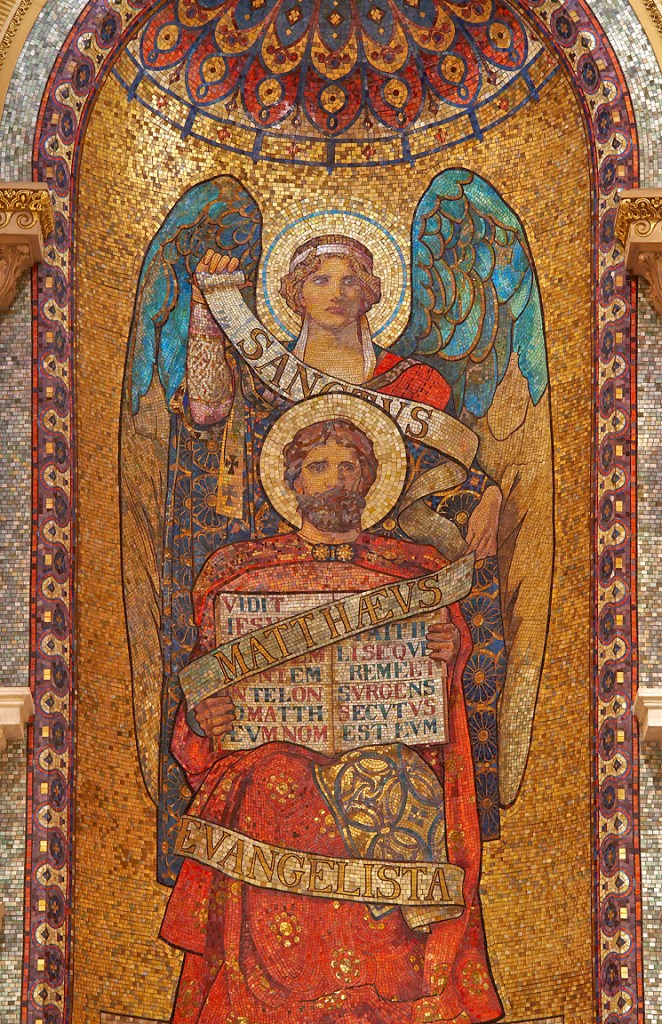
The Year of Matthew – Evangelist
- • • • Commentary available on UNIVERSALIS ↩︎
- Moloney, Francis J. This is the Gospel of the Lord Year A: Reflections on the Gospel Readings (Function). Kindle Edition. ↩︎
- Pope Francis made the “grandma’s lace” remark on 9 June 2022, in an address to the bishops and priests of Sicily, during an audience at the Vatican. In that speech he referred to priests’ use of lace-trimmed vestments and said that “sometimes bringing some of grandma’s lace is fine, but only sometimes,” urging them instead to celebrate the liturgy in the way “Mother Church wants to be celebrated.” The line has since been widely paraphrased as “lace is for grandmothers” in commentary on his liturgical style remarks.. See Perplexity aI Report. ↩︎
- Church on the move See Perplexity AI Report. ↩︎
- Recto tono … see Perplexity AI Report. ↩︎
- https://www.perplexity.ai/search/communion-with-the-catholic-ch-1aXyv5flQO.7vrJVR.kAdA#0 ↩︎
- See Evangelii Gaudium §94. ↩︎
- “indietrismo” and Pope Francis. See Perplexity AI Report. ↩︎
- Perfectionism vs Perfection by Deacon Douglas Mcmanaman ↩︎
- John 10:10. ↩︎
Leave a Reply