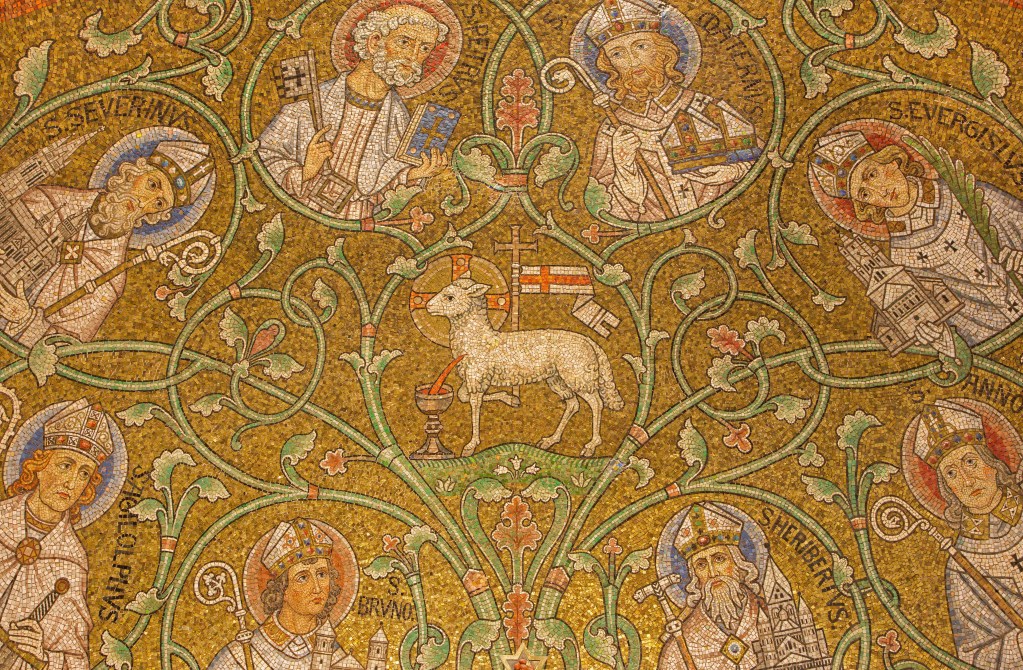
John 1:29
DOM HENRY WANSBROUGH OSB1
In contrast to the other gospels, where the reader observes the disciples discovering gradually who Jesus is, John gives us a week between the baptism and the marriage-feast of Cana, during which Jesus is given increasingly significant titles by those who meet him: Rabbi, the Messiah, Son of God, King of Israel. Perhaps the most significant of all are those given by the Baptist himself, Lamb of God and Chosen One of God. Lamb of God overarches the gospel, for it comes again at the Crucifixion. According to John Jesus dies at the moment the paschal lambs were being slaughtered in the Temple, and John alone refers to Jesus the scriptural saying ‘Not one bone of his will be broken’ (John 19.36), originally part of the instructions for the sacrificing of the lamb at the Festival of Passover (Exodus 12.46). In the Book of Revelation Jesus is represented standing ‘as a Lamb that seemed to have been sacrificed’. It is therefore an image both of his suffering and of his triumph. It links up with the picture of Jesus as the Suffering Servant of the Lord who moves through suffering and humiliation to vindication and to the triumph of God.
*
Dr FRANCIS J MOLONEY SDB2
The Lamb of God takes away the sins of the world because he is from God. It is as the Lamb of God that he takes away the sins of the world. Only God takes away, or forgives sins. Through the use of a sacrificed lamb, the people of Israel established and renewed their union with God and among themselves after sin. Jesus is now presented as the lamb, but he is not of the same order. He is not a ‘cultic offering’ taken from among us. Jesus is ‘of God’, given to us. The former rites of a sacrificed lamb, so important to the history, faith and culture of the People of God have been transcended. God now gives the fulness of pardon to Israel and to the whole world through the Lamb of God who takes away the sins of the world. Jesus is the one through whom God enters the human story, his Chosen One, offering it perfect reconciliation with him.
This new way to establish union between ourselves and our God has been made possible because the Lamb of God is the Chosen One of God. In Jesus of Nazareth, heaven and earth meet. The union between ourselves and the union with our God has been perfected in the gift of Jesus. This is an incredible claim, something we so often take for granted. There is need for wonder and delight at what God has done for us, leading to a grateful raising of our hearts and minds in prayer, in recognition of the gift of Jesus. One from among us has taken away the sins of the world, enabling us to become children of God (see 1:13).
*
RGG
We are beginning a little journey of six Sundays in Ordinary Time, bringing us to Ash Wednesday and Lent 2026. And once again, it is John the Baptist who prepares the Way for us and our Liturgical hard work of Ordinary Time 2026, the Year of Matthew.
We are also in the week between the Baptism of Jesus and the Marriage Feast of Cana, all flowing out of Epiphany. These weeks and Feasts are all liturgically epiphanic.3 This designation of Jesus as the Lamb of God, part of the Communion Rite in every Holy Mass at the fractio panis – the breaking of the bread …..is very rich. Recall Dom Wansbrough (above)
According to John Jesus dies at the moment the paschal lambs were being slaughtered in the Temple, and John alone refers to Jesus the scriptural saying ‘Not one bone of his will be broken’ (John 19.36), originally part of the instructions for the sacrificing of the lamb at the Festival of Passover (Exodus 12.46). In the Book of Revelation Jesus is represented standing ‘as a Lamb that seemed to have been sacrificed’.
Mother Church is opening up the Revelation that has taken place in the Nativity and Epiphanies of Jesus Christ, for us in the age-old Liturgy of the WORD. This Jesus Christ is revealing the Self-communicating Trinitarian God, and He is also the Revelation of God with us as Emmanuel.
But what of one’s own lowly lectio?
Well, first, I love the bit in the Gospel passage where Jesus is coming towards John the Baptist. We will see a bit of this over the next few weeks. But the first knockout thing about this season is to recall and celebrate God’s coming to us! No need to go sniffing around the Temple all day here !
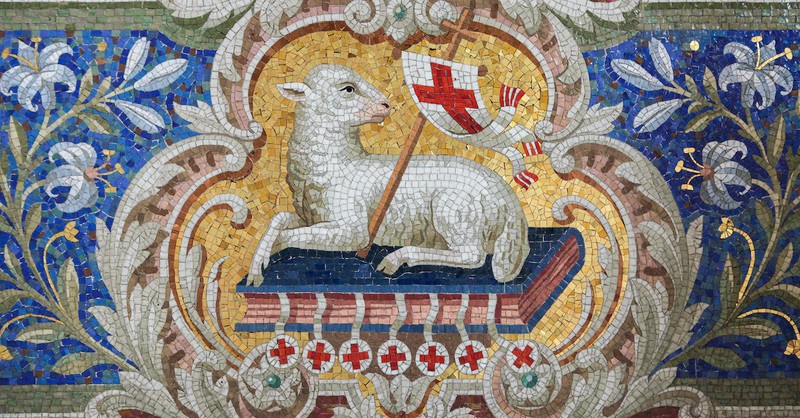
Seeing Jesus coming towards him, John said, ‘Look, there is the lamb of God that takes away the sin of the world.
Again and again in sacred scripture we hear of God’s coming towards us, of God speaking to us4 …. it seems to be very much a matter of our being able to “see” and “hear”… and John could do both. Notice in the Gospel the Baptiser says I did not know him myself,(twice in fact) … No! We can’t work it all out ourselves by our own effort. It is a work of grace, revelation, encounter …. we will learn during the year of Matthew that a disciple is one who can see with his eyes, hear with his ears, and has a heart that longs to know!5 (Matt 13:16). The Baptiser can “see”, “hear”, and “witness” to God at work in Jesus Christ – the “anointed one” (ie, the Christ). Mother Church is teaching us who Christ is, offering us her Christology! All foreshadowed in the Prophets. Isaiah’s Suffering Servant Songs are being fulfilled. Our first Reading today is the 2nd Song of the Servant in Isaiah 49. The Church’s Liturgy for Good Friday opens with the dramatic proclamation of the 4th Servant Song (Isaiah 52:13ff). Last Sunday, we heard the 1st Servant Song – Isaiah 42 – first Reading for the Baptism of the Lord.
Matthew is aware of Mark’s Gospel. The first account to be written down we believe. And it is in Mark that we have one of the earliest Christologies of Jesus. Tradition has it that Mark was St Peter’s Secretary, and so we have the teaching/preaching of Peter probably in Mark. Matthew faithfully records:
Even as the Son of Man came not to be served but to serve, and to give his life as a ransom for “many.”
Matt 20:28
It is all very rich, isn’t it? And it is about faithful transmission across centuries of the Revelation taking place in the coming of Jesus Christ
- Commentary available on UNIVERSALIS ↩︎
- Moloney, Francis J. This is the Gospel of the Lord Year A: Reflections on the Gospel Readings (Function). Kindle Edition. ↩︎
- Traditionally the “three epiphanies” are three Gospel events in which Christ’s divine identity is manifested in a particular way.
The three traditional epiphanies
The visit of the Magi to the Christ Child, where he is revealed as king and saviour of the nations (Matthew 2:1–12).
The Baptism of the Lord in the Jordan, where the Father’s voice and the descent of the Spirit reveal him as the beloved Son (e.g. Matthew 3:13–17; Mark 1:9–11; Luke 3:21–22).
The wedding at Cana, where by changing water into wine he “manifested his glory, and his disciples believed in him” (John 2:1–11).
In the older Roman liturgical tradition these three manifestations are closely associated with the feast and season of Epiphany, even when celebrated on different days. See Perplexity AI Report. ↩︎ - Right from the beginning in the Book of Genesis, God comes strolling in the garden in the cool of the evening looking for Adam and Eve! “Where are you? He says.” Genesis 3:8-9. ↩︎
- Matthew 13:16. ↩︎
Leave a Reply